
Why does it seem Google is ghosting your GBP/ Maps/ Business?
JumpStart Matrix · April 2026 Estimated read time: 6 minutes
Ever feel like you’re shouting into a void?
You’ve submitted the paperwork. You’ve filmed the video walkthrough. You’ve followed every step Google asked for……And yet your Google Business Profile sits there, mocking you “Pending,” “Rejected,” or worse, “Suspended.”
You haven’t done anything wrong. So why won’t Google verify your business?
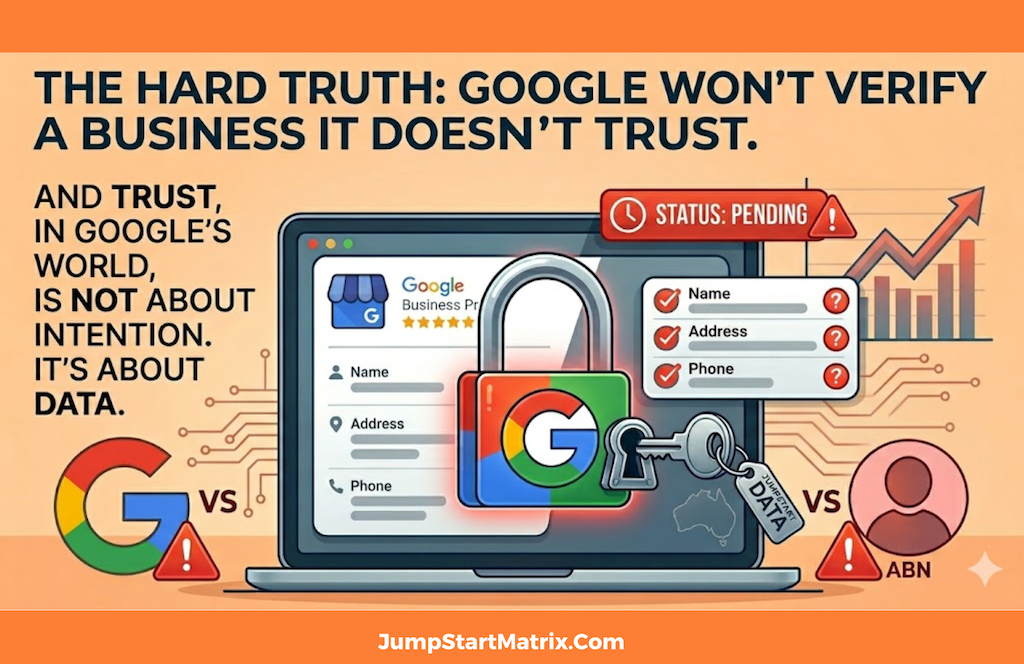
The hard truth is this: Google won’t verify a business it doesn’t trust. And trust, in Google’s world, is not about intention. It’s about data.
Lets walk through the ‘Trust Blueprint’ facts.
Google Suspensions Are Not Bad Luck — They’re a Crisis
Before we get into the Trust Blueprint itself, let’s be clear about what’s happening across the board right now, because you are not alone, and this is not random.
GBP suspension reports increased by over 80% between Q1 2023 and Q2 2024, according to Asset Digital/ BrightLocal.
Sterling Sky, one of the world’s leading local search agencies, reported that their suspension-related support tickets doubled in the first half of 2024 compared to the previous year.
It got worse from there.
Throughout September and October 2025, small business forums exploded with reports of unexplained suspensions.
According to Search Engine Journal, appeal resolution times ballooned from around 5 days to nearly 5 weeks during peak periods, meaning suspended businesses were invisible on Google Maps for over a month while waiting for an answer.
And the kicker: 61% of affected businesses experienced measurable drops in leads or calls during their suspension, according to a 2024 Local Search Forum poll.
This is not a minor inconvenience. For a local business, losing your Google Maps presence can be devastating.
Already have issues? Book our GBP Strategy Kickstart CallWhy Is This Happening to Legitimate Businesses?
Google is in the middle of a massive clean-up operation.
In 2022, they removed over 20 million fake business profiles from Maps and Search.
In 2023, they blocked or removed over 115 million policy-violating reviews.
The scale of spam and fraud on the platform has pushed Google to deploy increasingly aggressive AI-driven enforcement systems.
The problem? These automated systems can’t always tell the difference between a spam farm and a legitimate business that happens to have slightly inconsistent data.
As one local SEO expert put it in the Local Search Forum: “The humans at Google must have released updates to feed their AI algos.”
Even small edits can now trigger an automatic review. A change to your phone number. An update to your business hours. A new photo.
Any of these can flag your profile for review and that review can turn into a suspension if the AI spots anything it doesn’t like.
According to a 2025 analysis by 20 Minute Marketing (an Australian digital agency), the August 2025 policy updates caused a significant spike in suspensions specifically because Google’s automated enforcement systems began flagging legitimate businesses that had technically violated guidelines without any malicious intent.
What Google Is Actually Looking For: The Trust Score
Google doesn’t publish a metric called a “Trust Score.” But make no mistake, it exists.
Google’s algorithm cross-references your GBP data with third-party sources, user reports, behavioural signals, review patterns, and location signals to determine whether your business is legitimate.
It’s looking for what local SEO professionals call Entity Verification; evidence that your business is a real, consistent, credible entity in the real world.
The logic is brutally simple: Inconsistency = Risk.
If your phone number on your website doesn’t match your GBP
If your business name on an old directory is slightly different from your registered name.
If your address is formatted differently across platforms.
Google’s AI flags all of it……… and your trust score takes a hit.
The NAP Problem: Small Inconsistencies, Big Consequences
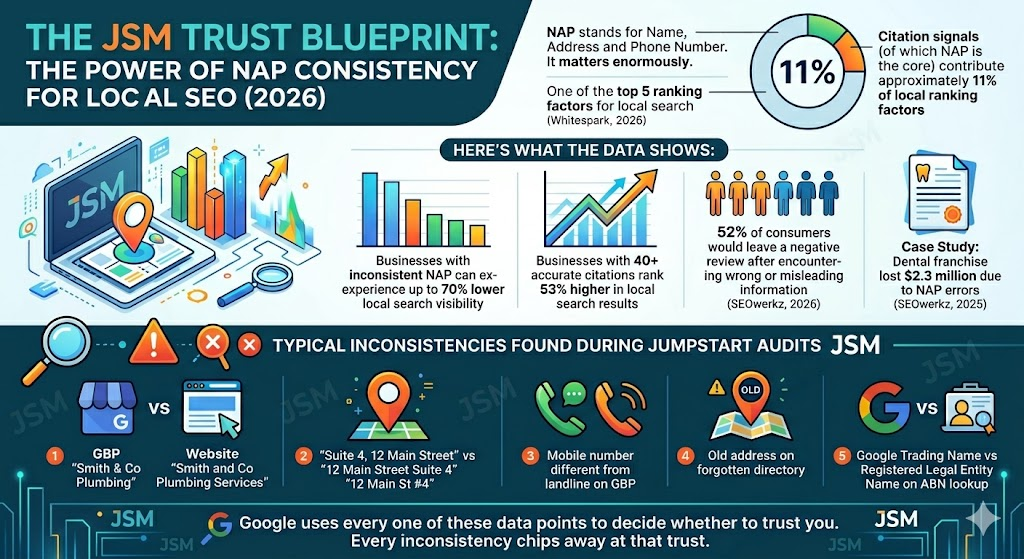
The importance of NAP (Name, Address or Phone) consistency can have a big impact not only on Google and its ‘trust’ in your business, but also on your local customers.
NAP stands for Name, Address and Phone Number.
It sounds almost too simple to matter. It matters enormously.
According to Whitespark’s local ranking factors research, NAP consistency remains one of the top 5 ranking factors for local search in 2025.
Citation signals (of which NAP is the core) contribute to approximately 11% of local ranking factors overall.
Here’s what the data shows:
• Businesses with inconsistent NAP information can experience up to 70% lower local search visibility compared to those with consistent data
• Businesses with 40+ accurate citations rank 53% higher in local search results compared to those with fewer listings
• 52% of consumers say they would leave a negative review after encountering wrong or misleading information on a local business listing (SEOwerkz, 2025)
• SEOwerkz has a case study on a dental franchise lost $2.3 million due to NAP errors across their directory listings (SEOwerkz, 2025)
The typical NAP inconsistencies JumpStart find when we audit a profile are almost always invisible to the business owner.
Things like:
• “Smith & Co Plumbing” on your GBP vs “Smith and Co Plumbing Services” on your website
• “Suite 4, 12 Main Street” vs “12 Main Street Suite 4″ vs “12 Main St #4” — all the same address, all flagged as different
• A mobile number listed somewhere that’s different from the landline on your GBP
• An old address from before you moved, still sitting on a directory you forgot existed
• Your trading name on Google vs your registered legal entity name on ABN lookup
Every one of these is a data point Google uses to decide whether to trust you. Every inconsistency chips away at that trust.
The 6 Most Common ‘Trust Killers’ We Find
After 16+ years of auditing Google Business Profiles, these are the issues JumpStart see most often, and the ones that do the most damage:
1. NAP inconsistency across the web: As above. Your name, address, and phone number need to be identical everywhere — not just similar.
“St” vs “Street” is enough to create a trust signal mismatch.
2. Category stuffing or misalignment : Selecting too many categories, or the wrong primary category, looks suspicious to Google’s AI.
A plumber who lists themselves as “Plumbing, HVAC, Electrical, General Contractor, and Handyman” looks like a lead farm, even if they legitimately offer all those services.
3. Stock photos and weak visual proof: Google’s AI now reads your photos to verify your business is real and operating from the location you’ve claimed.
Stock images provide no verification value. As Google stated in a 2024 platform integrity blog post: “As we develop more AI-powered features, the quality of our local business data is more critical than ever.”
4. Missing or inadequate business description: A thin or keyword-stuffed description signals low quality.
Google rewards profiles that clearly and accurately describe what the business does in natural language.
5. Unverified or outdated information on third-party directories: Old listings on Yellow Pages, True Local, Hotfrog, or industry directories that have been forgotten are actively working against you, even if they predate your current business structure.
6. A previous agency’s bad practices still attached to your profile: This one surprises people. If a previous marketing agency used shortcuts; keyword stuffing in your business name, fake reviews, virtual office addresses, those violations can still be sitting on your profile and triggering Google’s enforcement systems right now.
Get Your Free GBP Review!The Google GBP Verification Loop — and How to Break It
The cruelest thing about GBP verification issues is the loop they create.
You submit a verification request. Google asks for more information. You provide it. Google rejects it. You try again. Google suspends the profile entirely. You appeal. The appeal takes weeks. It gets rejected.
You’re back to square one, but now your profile has a history of failed appeals, which makes the next attempt harder.
According to StubGroup’s 2025 analysis, the median time to fix a Google suspension (for businesses who hired professional help after failing on their own) was 32 days. Some suspensions stretch on for years.
The businesses that break the loop are the ones who come in with the right evidence, in the right format, understood by Google’s current AI standards and don’t make the common mistakes that reset the clock.
This is what the Trust Blueprint is designed to do.
JumpStart’s Strategy: The Trust Blueprint
As part of our $495 AUD GBP Rescue Package, we implement The Trust Blueprint; a forensic data alignment process designed to close the Trust Gap between your business and Google’s verification requirements.
We don’t just hit “resubmit” and hope for the best.
Here’s what the Trust Blueprint actually involves:
Step 1 – The Data Audit
We perform a deep-scan of your business data across the web; GBP, your website, major directories, data aggregators and industry listings. We identify every inconsistency, discrepancy, and trust signal mismatch that Google’s algorithm is currently using against you.
Step 2 – The Alignment
We correct and standardise your NAP data across every platform that matters. We ensure your registered business name, trading name, address format, phone number, and website URL are identical wherever they appear.
Step 3 – The Entity Verification
We align your profile with Google’s current ‘Entity Verification’ requirements, ensuring your business can be cross-referenced and confirmed as a legitimate, consistent entity across multiple authoritative sources.
Step 4 – The Visual Proof Audit
We audit your current photo library and provide a clear brief on what replacement imagery Google’s AI needs to see — real photos of your team, your premises, your work, and your signage that confirm your physical presence and expertise.
Step 5 – The Appeal (where required)
If your profile is suspended, we prepare and submit a professional reinstatement appeal with the specific documentation Google requires. Not a generic appeal, a strategically constructed case built around your profile’s specific trust gap.
The result: a profile that Google’s algorithm can verify, trust, and rank, without triggering future enforcement flags.
Stop the Verification Loop
A suspended, pending, or underperforming Google Business Profile isn’t just frustrating. Every day it’s not working is a day your competitors are capturing the customers who were looking for you.
Given that 46% of all Google searches have local intent, and that ranking in the Local 3-Pack generates up to 70% of all local clicks, your GBP is one of your most valuable (and most vulnerable) business assets.
The Trust Gap is fixable.
But it needs to be fixed properly, by people who understand exactly what Google is looking for , and exactly what it penalises.
Is your Google Trust Score holding you back?
Start with a Free GBP Review!
Already have issues? Book our GBP Rescue Package
JumpStart Matrix are Google Experts based in Coffs Harbour, NSW. We have been helping Australian businesses fix, optimise, and protect their Google Business Profiles for over 17 years.