
Geofencing in Advertising
People talk about Geofencing, most of what you've heard is half right, and some of what's being sold isn't Geofencing at all. Here's how location-based advertising actually works, what it genuinely costs, and how we approach it at JumpStart as a bespoke service, because that's the only honest way to do it. Book A Strategy Call NowHow Geofencing Works↓17+ Years helping Australian SMEs | Coffs Harbour, NSW
17+ Years helping Australian SMEs | Coffs Harbour, NSW
What is Geofencing?
(The Plain English Version)
(The Plain English Version)
Imagine drawing a fence around a place; your business, a competitor’s showroom, an event venue, a new housing estate.
Not a real fence. A digital one.
When someone’s smartphone crosses into that fenced area, they can become part of an audience you advertise to.
Your ad can appear on their phone while they’re inside the fence or follow up with them later, after they’ve left.
That is Geofencing. You’re reaching people based on where they physically are or have recently been, not just what they’ve typed into
a Search Engine.
This technology is already in almost everyone’s pocket. When location services are switched on, a phone communicates its position through GPS, WiFi, Bluetooth and mobile data. Geofencing platforms tap into those signals.
One honest caveat most providers skip: the precision isn’t magic. Smartphone GPS carries a real-world error of several metres, and it worsens around tall buildings and indoors . Building-level fencing is genuinely possible, but anyone promising surgical, to-the-doorstep accuracy is overselling, and we’d rather you know that up front.
How Geofencing Works
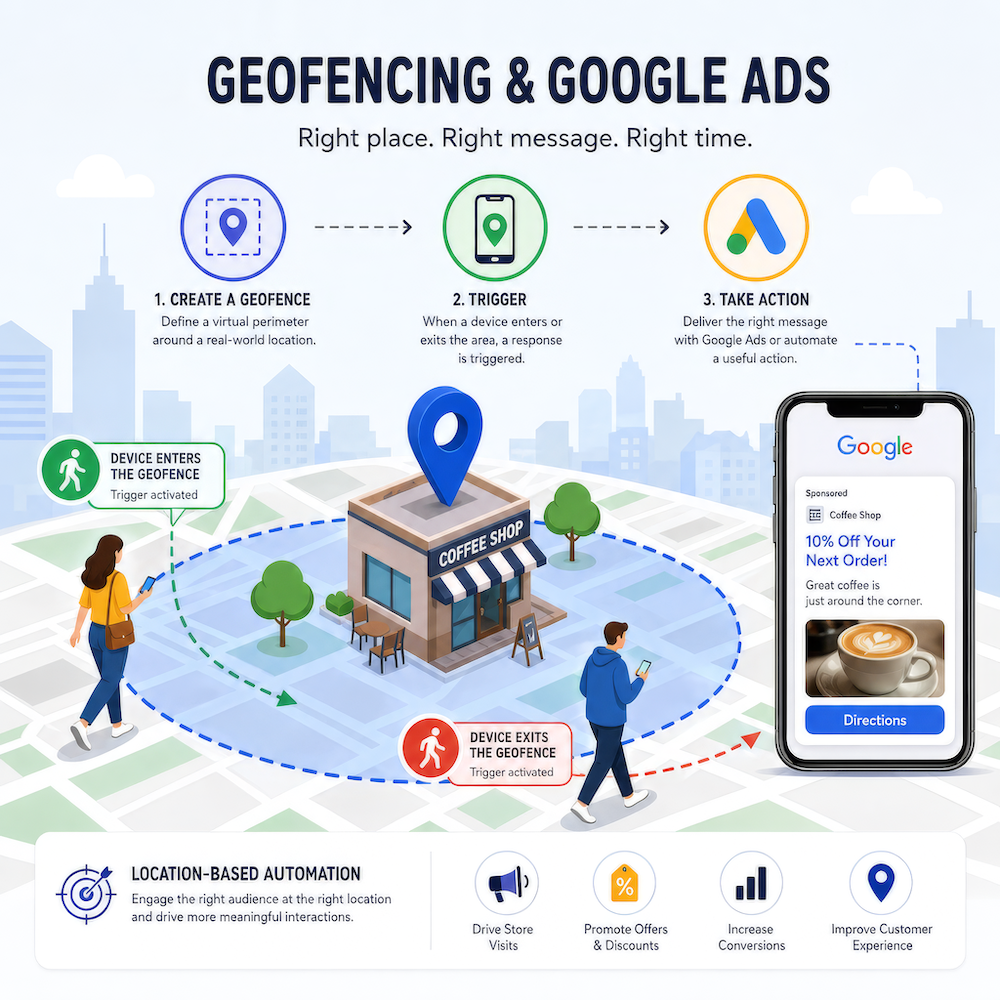
A geofence isn’t just a “show an ad” switch.
Campaigns are built around triggers; moments when movement tells you something useful:
- Entry trigger – an ad fires when a device enters the fenced area
- Exit trigger – an ad fires when it leaves
- Dwell trigger – an ad fires after a device has been inside the fence for a set time (they didn’t just drive past, they stopped)
- Post-visit re-targeting – anyone who entered the fence joins an audience you can advertise to for days or weeks afterwards
That last one is where most of the value sits.
Someone who spent twenty minutes at a competitor’s showroom on Saturday can see your ad on Tuesday night, on the couch, scrolling.
Ads are delivered as mobile display ads (in apps and browsers), video, social ads, and increasingly connected-TV placements (CTV)
The Google Ads Reality
(This Is the Part Nobody Explains)
(This Is the Part Nobody Explains)
Here’s the thing that surprises most business owners: Google Ads does not have a campaign type called “geofencing.”
Plenty of agencies sell “geofencing on Google.”
What Google actually offers is location targeting, built into every campaign type: Search, Display, YouTube, Performance Max.
It’s powerful, it’s where most local campaigns should start, and most accounts we review have it configured poorly. But it is not the same thing as true geofencing.
Google Ads location targeting serves ads to people in a defined area based on their search and browsing behaviour. Radius targeting bottoms out at roughly a 1-kilometre radius. It’s brilliant at catching people actively looking for what you offer.
Meta (Facebook/Instagram) location targeting offers radius targeting around an address or dropped pin. Worth knowing: Meta has progressively reduced advertiser control here in 2023. Its consolidated its location options so most new campaigns can only target “people living in or recently in” an area, removing the ability to separately target residents, recent visitors or travellers.
Useful layer; blunt instrument.
True geofencing targets people based on real-world physical movement, down to an individual building.
A competitor’s front door. A display village. An event venue. It catches people who haven’t searched at all.
This runs on specialist ‘programmatic’ platforms (the industry names are demand-side platforms like Simpli.fi and GroundTruth) a different layer of the stack entirely, not native to Google Ads or Meta.
None of these is “better”, they do different jobs and the strongest local campaigns use them together, deliberately.
One Setting Most Ad Campaigns Get Wrong
Before the clever stuff, here’s the unglamorous fix that saves advertisers real money.
Inside every Google Ads campaign sits a collapsed section called “Location options.”
It holds two choices:
• “Presence or interest” – Shows your ads to people in your area and to people anywhere who’ve shown interest in your area.
• “Presence” (people in or regularly in your targeted locations) – Shows your ads only to people who are actually there.
Google’s own documentation confirms the broad option is the default, and that most campaigns see impressions drop when they switch to Presence-only, which tells you exactly how much of that default reach was never in your service area to begin with.
Independent PPC (Pay Per Click) specialists consistently flag this default as one of the most common sources of wasted local ad spend.
The practical effect: a plumber’s ads showing to someone three states away (or another country) because they once searched content about your city. For a business that serves a physical area, that’s budget quietly leaking out of the region.
We check this setting on every account we review. You’d be surprised how often it’s still on the default.
One more lever while you’re in there: radius targeting pairs with location bid adjustments, bidding higher for people physically closest to you, because proximity correlates with likelihood to show up.
The Three-Layer Local Ads Funnel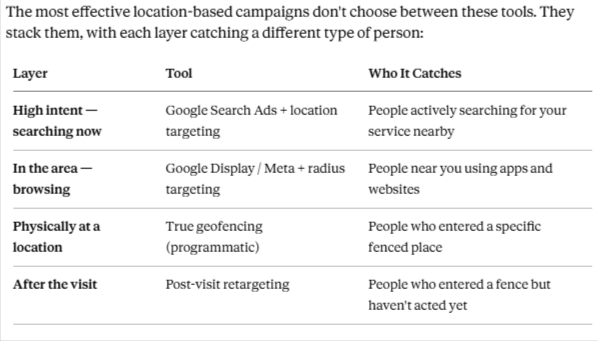
The logic: search ads capture the hand-raisers -people already looking.
Geofencing catches everyone else; people physically present who haven’t searched yet.
The fence builds the audience; the retargeting converts it.
Run one without the other and half the funnel stays empty.
What This Looks Like in the Real World
What This Looks Like in the Real World
The four below campaign types/ patterns that show how location thinking changes the game, and why the right answer is always specific to the business.
Notice two things:
First: in every case, physical movement reveals intent that search data can’t see.
Second: no two of these campaigns look anything alike ; different fences, different triggers, different follow-up, different budgets.
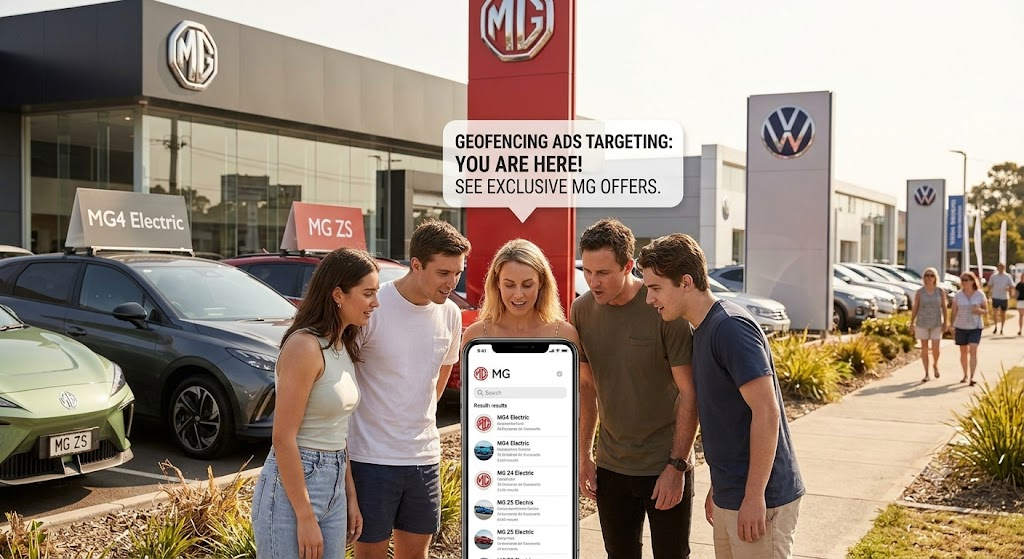
Car Dealership
Fence competitor dealerships.
Anyone walking a competitor’s lot on Saturday morning is in-market right now and can see your offer that afternoon.

Retirement Village
Instead of advertising to “people aged 65+ in the region,” fence the alternative housing options prospective residents are already visiting. You reach people at the exact moment they’re comparing.
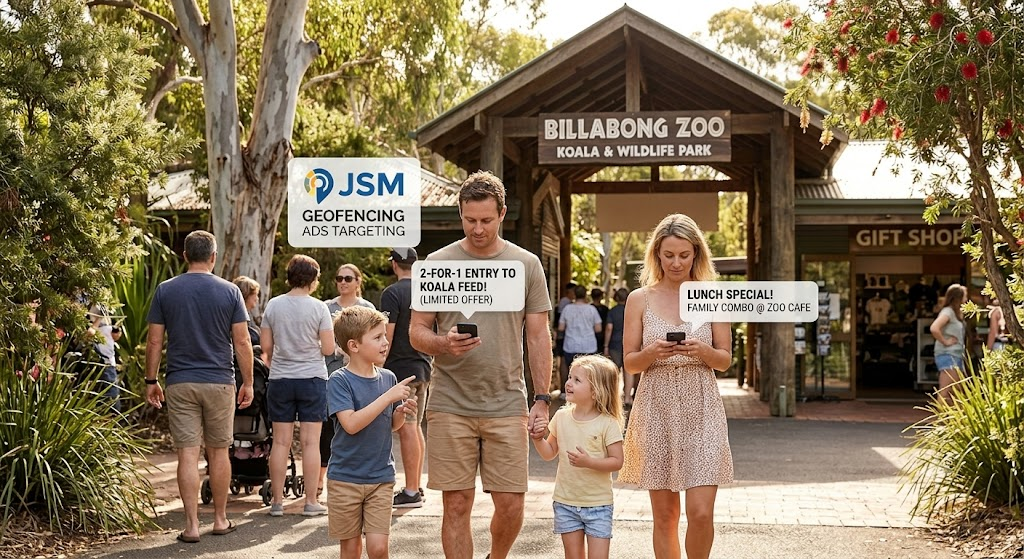
Holiday Resort
Fence the region’s tourist attractions and visitor hotspots.
Everyone inside those fences is, by definition, a visitor; already there, already spending, still deciding where to stay and eat.
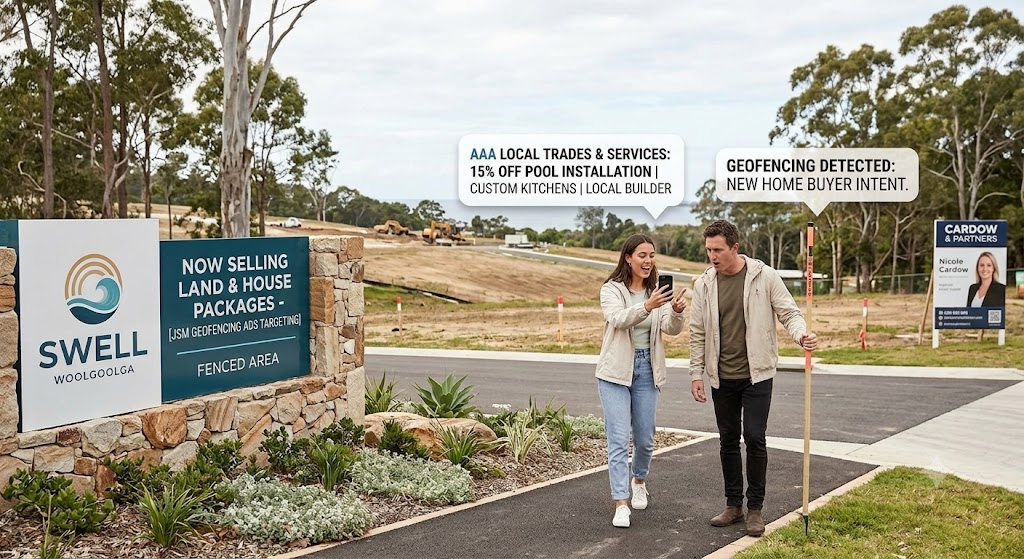
Building Company
Fence a new land release.
Everyone walking that estate is somewhere on the journey to building a home. No search keyword required -their feet already told you.
The Honest Cost Conversation
True “Geofencing” can be (and often is) an expensive way to advertise and we’d rather tell you that here than after you’ve booked a call.
Here’s why:
It’s bought by the impression, not the click.
Programmatic geofencing is priced on CPM (cost per thousand impressions).
Industry pricing typically runs around US$3.50–$15 CPM for mobile display, and US$20–$50 for connected TV [5][8].
Local reseller and agency routes commonly add a 20–40% markup on top of platform rates [1].
The platforms have entry barriers.
Direct access to a leading platform like Simpli.fi is generally reported to require US$10,000–$20,000 per month in minimum ad spend [1][9].
Reseller and white-label routes open the door at much lower budgets, but the markup structure above is how that access is paid for.
It needs volume and time to work.
Because it’s impression-based, geofencing has to build an audience pool before retargeting can convert it.
Very short campaigns on very small budgets routinely disappoint, not because the method failed, but because it never had the fuel to work.
The fence is only half the campaign.
Creative, landing pages, tracking and reporting all carry real cost. A precisely targeted ad pointing at a website that doesn’t convert is precision-wasted money. Sometimes the right answer is genuinely: don’t buy geofencing yet.
For many businesses, correctly configured Google Ads location targeting (often just fixing the settings) delivers more return per dollar than a premature programmatic campaign.
JumpStart will tell you which one you are.
Need an Online Marketing Expert?
Talk to JSM About Location-Based Advertising!
JumpStart Matrix is an established Agency, a Google Partner with a team spanning Australia and the United States,
building campaigns for clients wherever they are.
We build location-based advertising the way this page describes it:
Ensuring that Google Ads configured correctly first, Geofencing scoped to your business, not pulled off a rate card and honest answers
on the cost of a Geofencing campaign. We’ll look at how your customers actually move, what your current setup is doing (and wasting)
and what a build designed for your business, would look like.
Wondering whether Geofencing earns a place in your Marketing plan? Start with a conversation.
Need an Online Marketing Expert?
JumpStart Matrix is an established Agency, a Google Partner with a team spanning Australia and the United States, building campaigns for clients wherever they are.
Wondering whether Geofencing earns a place in your Marketing plan? Start with a conversation.
We’ll look at how your customers actually move, what your current setup is doing (and wasting)
and what a build designed for your business, would look like.
Talk to JSM About Location-Based Advertising!
The JSM Approach to Geofencing
Bespoke NOT Packaged
Bespoke NOT Packaged
You’ll find plenty of providers selling geofencing in fixed bundles; set fee, set number of fences, same deliverables for a café as for a car dealership. That’s not how we work, because it’s not how the work actually behaves.
Everything above should make the reason obvious: the right build depends on what you sell, who buys it, where they physically move, what your margins can support, and whether your website is ready to convert the attention.
A campaign fencing five competitor showrooms with 90-day re-targeting has almost nothing in common with a four-week seasonal push around a single event — in cost, in platform or in strategy.
Pricing them the same would mean overcharging one client and under-delivering for the other.
Every JSM engagement is scoped individually, and pretty much always in the same order:
1. Site and Setup Review first.
2. Strategy before Spend.
3. Build, Measure, Report (with real numbers)
And because the fences are digital, so are we! JSM operates across Australia and the United States, and we build location-based campaigns for clients anywhere in the world. Local knowledge matters, but it’s the method that travels.

1. Site & Setup Review
If your website or tracking isn’t ready to convert traffic, we’ll tell you and we won’t take your money to send ads to it until it is.

2. Strategy before Spend
Which layers of the funnel you actually need, in what order, on what budget, including the recommendation to start smaller than you expected, if that’s the truth.

3. Build, Measure & Report
(w/ real numbers)
No inflated reach figures, no manufactured results. If a campaign under performs, you’ll see that too, along with what we’re changing.
1. Site & Setup Review
If your website or tracking isn’t ready to convert traffic, we’ll tell you and we won’t take your money to send ads to it until it is.
2. Strategy before Spend
Which layers of the funnel you actually need, in what order, on what budget, including the recommendation to start smaller than you expected, if that’s the truth.
3. Build, Measure & Report
(w/ real numbers)
No inflated reach figures, no manufactured results. If a campaign underperforms, you’ll see that too, along with what we’re changing.
A Few Words on Privacy
A Few Words on Privacy
Location-based advertising has to be done properly and the regulatory bar is rising, which we think is a good thing.
Community expectations are ahead of the law, with the overwhelming majority of Australians consider targeting based on sensitive information unfair.
In Australia, Privacy Act reforms passed in 2024 have already strengthened enforcement, with further tranches of reform expected, including explicit treatment of targeted advertising and an expanded definition of personal information that captures device identifiers and location signals [10][11]. The regulator has become notably more active, opening 2026 with its first-ever privacy compliance sweep [12].
Clients in other markets face their own frameworks (GDPR in Europe, a patchwork of state laws in the US) and campaign design has to respect the strictest rule that applies.
Geofencing done right works with anonymised, aggregated device audiences. It doesn’t identify individuals and it doesn’t follow named people around. When JumpStart build location-based campaigns, transparency and compliance are part of the setup, not an afterthought!
IF a tactic wouldn’t pass the “would a reasonable customer be comfortable with this?” test, we don’t run it.)

About Maggie & JSM
JumpStart Matrix is a Digital Marketing Agency based in Coffs Harbour, NSW, with 17 years of experience helping Australian small and medium businesses grow online.
We specialise in SEO, Google Ads, and local search and we work with a select number of clients, because we partner for the long term, not the quick win.
When it comes to your business online presence, we’re not guessing. We’re applying the same diagnostic approach we use across all our client work, evidence first, then action. We don’t guess. We diagnose.
Call the JSM Team on (02) 5698 5445 or email us at Info@JumpStartMatrix.com.